

A rock chip doesn’t automatically mean you need a new windshield. A chip an inch or less in diameter is generally a repair candidate, but damage in the driver’s direct line of sight may call for replacement because resin can leave a visible mark. Whether a rock chip can be repaired depends mainly on its size and location, while a larger crack presents a different decision.
It’s understandable to want a clear answer before deciding what to do. This guide explains how chip size and placement affect repair eligibility, what factors influence repair costs, and how insurance and vehicle inspections may matter. You’ll also learn what to expect from the repair process and how long an appointment can take.
A mobile windshield repair appointment commonly takes just under an hour from start to finish. The sections ahead compare repair and replacement so you can understand which option fits the damage and why.
Key Takeaways
- Compare repair and replacement by considering the damage’s spread, location, and effect on visibility.
- Before work begins, ask your insurer how your coverage applies; policy terms and the work required affect your out-of-pocket cost.
- Address damage before it spreads or interferes with your view, and keep windshield condition in mind when preparing for vehicle inspection.
- If the damage calls for replacement rather than repair, windshield replacement can restore the glass as the next step.
Chip repair cost and insurance coverage
Repair and replacement involve different work. The right option depends on the damage, the service needed, and any insurance coverage or deductible that applies.
Chip Repair Costs
Chip repair uses resin to fill windshield damage, rather than replacing the entire glass. Its cost depends on the chip’s size, location, and repairability, since damage outside repair limits may require a different service. The price depends on the case and is given after a quote request; the damage’s extent, location, and repair method affect the quote.
A repair addresses a smaller damaged area, while replacement involves the full windshield. For example, a contained chip and a spreading crack can call for different work, even on the same vehicle model.
Insurance Coverage and Deductibles
Insurance coverage for chip repair depends on your policy, so there isn’t one rule for every driver. A deductible is the amount you pay toward a covered claim before insurance contributes. If your deductible exceeds the repair cost, paying directly may make more sense than filing a claim.
Before authorizing work, ask your insurer how your policy handles windshield repair, whether a deductible applies, and whether approval is needed. This can clarify your expected share and prevent billing confusion. Don’t assume coverage for repair also applies to replacement; your policy may handle them differently.
| Option | Work involved | Cost consideration |
|---|---|---|
| Chip repair | Resin fills localized damage | Depends on damage and repairability |
| Insurance claim | Coverage follows policy terms | Deductible affects your share |
| Windshield replacement | Entire windshield is replaced | Scope of work differs from repair |
Use the table to compare the repair method with your policy’s deductible and coverage terms. If your insurer requires approval, get it before starting the repair. Keep the claim details and estimate together so you can compare your expected payment with the deductible.
Can a chipped or cracked windshield pass inspection?
A damaged windshield can affect visibility and inspection results. In most U.S. states, a crack can cause inspection failure, particularly when it blocks the driver’s line of sight.
Chip and Crack Size Thresholds
Size helps distinguish a repair candidate from damage that may need replacement. A windshield crack larger than a dollar bill may compromise the glass’s structural integrity and likely require replacement. A smaller chip is not automatically harmless: its position and effect on the driver’s view matter as much as its dimensions.
Location can outweigh size. Even a small chip or crack directly in the driver’s line of sight may call for replacement because repair resin can leave a visible mark. Blocked vision is a key inspection concern, so don’t judge damage by its diameter alone.
Repairable Chip Types and Sizes
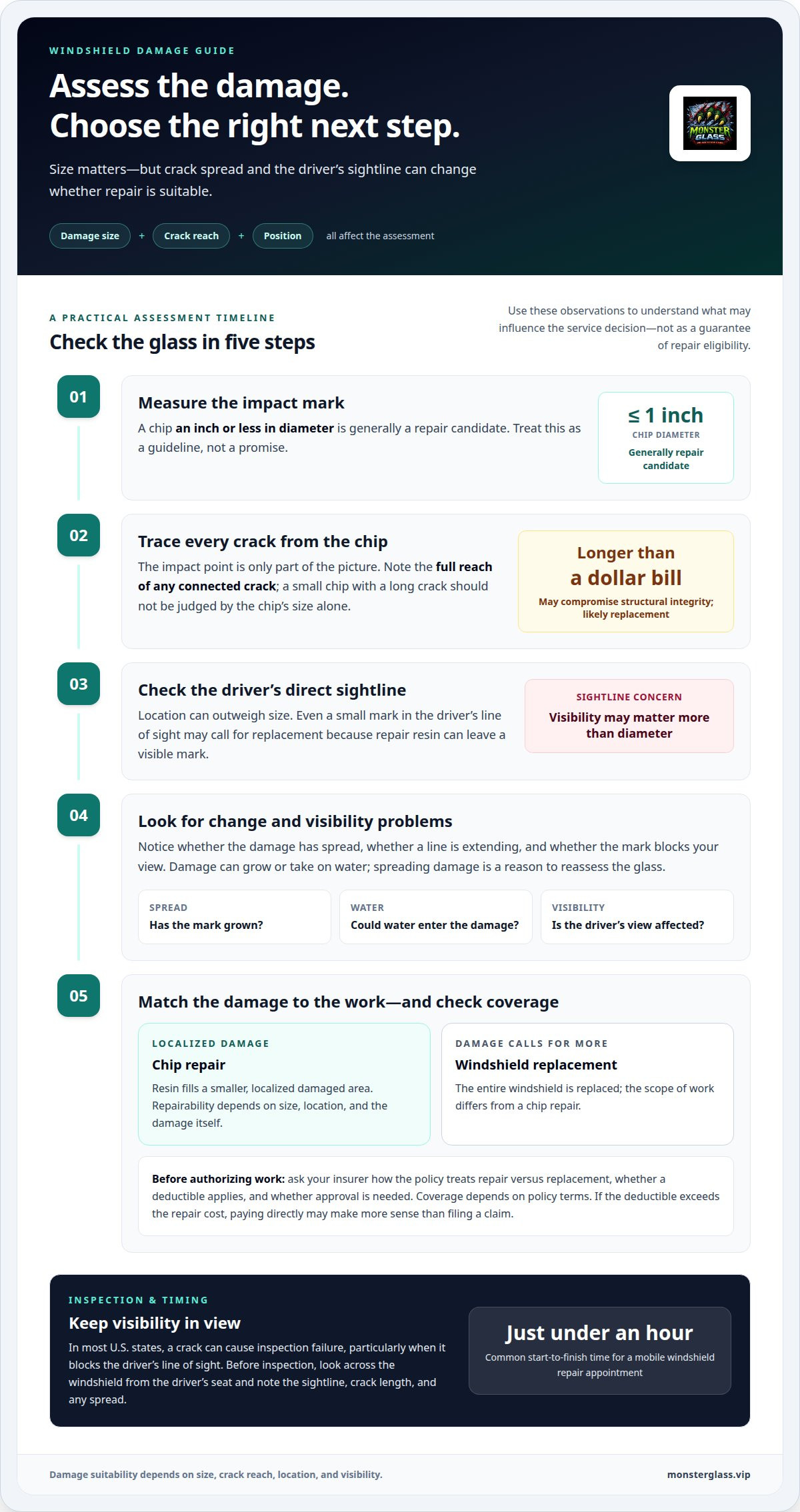
A chip an inch or less in diameter is generally a repair candidate. That’s a useful guideline, not a guarantee: cracks extending from the impact point or a mark within the driver’s sightline can change the decision. A technician considers both the chip’s reach and its position.
Unlike a crack larger than a dollar bill, a small, localized chip may be suitable for resin repair. Still, damage of any size should be assessed because it can grow, take on water, or obstruct vision. An inch-wide chip outside the sightline may have different repair prospects from a smaller one in front of the driver.
To limit worsening, arrange repair promptly rather than leaving a chip exposed to further damage. Keep the driver’s view clear, and treat any spreading line as a reason to reassess the glass. Water entering damaged areas can complicate the damage, while a growing crack may shift the decision toward replacement.
Before an inspection, look across the windshield from the driver’s seat. Note whether damage sits in the direct sightline, whether a crack extends beyond a dollar-bill length, and whether the mark has spread. These observations help distinguish a localized chip from damage that could compromise visibility or structural integrity.
If damage sits in your sightline or keeps spreading, explore windshield damage options before your next inspection.
Damage-size and impact-point limits
Repair suitability depends on more than the visible mark’s diameter. Consider the chip’s size, any cracks extending from it, and its position on the windshield.
A chip an inch or less in diameter is generally a repair candidate. That measurement describes the impact mark, not necessarily any cracks branching away from it. A small central chip with no visible spreading differs from a wider area of damage. Note both the chip’s diameter and the full reach of any connected crack.
Crack length changes the assessment. A crack larger than a dollar bill may compromise the windshield’s structural integrity and likely require replacement. This differs from measuring a compact chip: the crack’s total span matters, even if its original impact point looks small. For example, a small chip with a long crack cannot be judged by the chip alone.
- Small, localized mark: An impact point measuring an inch or less is generally a repair candidate.
- Extended crack: A crack longer than a dollar bill may point toward replacement, even when its starting chip is small.
- Driver’s sightline: A small mark directly in this area can still make repair unsuitable.
Position can outweigh size. Repair resin may leave a visible mark, so a chip directly in the driver’s line of sight may require full windshield replacement. For example, an inch-wide chip outside that area and a smaller chip in front of the driver present different concerns. The first may fit the general size guideline; the second may affect clear vision after repair.
To assess the damage before arranging service, look at the impact point, then trace every visible crack to its farthest end. Compare the chip’s diameter with an inch and the crack’s length with a dollar bill. Finally, check whether the mark sits in the driver’s direct line of sight. These observations help distinguish a possible repair from damage that may need replacement.
What types and sizes of windshield chips can be repaired?
A windshield chip an inch or less in diameter is generally a repair candidate. That guideline describes size, but the visible shape alone doesn’t settle whether repair is suitable. Check whether cracks extend from the impact point, how far they reach, and where the damage sits on the glass.
Resin injection fills the damaged area, helps restore glass strength, and helps prevent a crack from progressing. A compact chip and one with visible cracks branching away from it therefore need different assessments. Note the mark’s width and any branching before deciding what service it may need.
- Measure the impact mark: Compare its diameter with the inch guideline.
- Trace visible cracks: Note whether lines extend beyond the chip.
- Check its position: Identify whether the damage sits in the driver’s direct line of sight.
For example, a localized chip measuring less than an inch may be a repair candidate if the damage remains contained. A similar-sized impact with a crack extending across the windshield is a different case. The total damage, rather than the chip’s label or shape, helps determine whether resin repair is appropriate.
Location also changes the decision. Resin can leave a visible mark, so damage directly in the driver’s line of sight may require replacement, even if the chip is small. That makes a small mark near the edge different from one in front of the driver. Both size and position matter; neither should be assessed alone.
Use these observations to describe the damage clearly: measure the impact, trace any cracks, and note the sightline. If the windshield chip appears localized and falls within the inch guideline, arrange an assessment for windshield chip repair. If cracks extend beyond the impact point or the mark affects the driver’s view, include those details when considering the next step.
Monster Glass: Windshield Replacement
Monster Glass provides Windshield Replacement when a damaged windshield calls for more than chip repair. A crack extending beyond repair limits or damage affecting the driver’s sightline can make replacement the appropriate next step. For a localized chip that remains suitable for repair, Monster Glass also offers Windshield Rock Chip Repair.
The distinction matters: resin repair treats localized damage, while replacement addresses the windshield as a whole. If the chip has spread into a long crack, or its position could leave a visible mark in the driver’s view, replacement can address the damaged glass directly. Monster Glass also provides General Auto Glass Replacement and Car Window Replacement for other damaged vehicle glass.
Contact Monster Glass to discuss windshield repair or replacement for your vehicle.
Choose Your Next Step With Confidence
Move from uncertainty to a clear service decision. If you’re wondering whether a rock chip can be repaired, describe the visible damage and your main concern, such as visibility or a crack that seems to be changing. A focused description keeps the conversation centered on your windshield and what you need next.
Before reaching out, note where the damage appears from the driver’s seat and whether it has changed since you first noticed it. If an inspection is approaching, mention that timing as context, not as a reason to assume a particular outcome. Keep any relevant insurance instructions nearby if you plan to discuss a claim. These details can help make the next conversation more useful.
Monster Glass can help you move from uncertainty toward a practical next step for your damaged glass. Share what you’ve observed, then let the conversation focus on the right service for the issue. Ask Monster Glass about your chip and take the next step with confidence.
Frequently Asked Questions
How do I know if my windshield can be repaired?
Start by checking three things: impact diameter, crack spread, and position. A chip no wider than an inch, with no branching crack and outside the driver’s direct sightline, fits the general repair criteria. Trace any visible branches across the glass and view the mark from the driver’s seat. If a crack runs beyond a dollar bill or affects visibility, note that before arranging an assessment.
What is the best way to fix a small chip in a windshield?
A professional resin-injection repair is appropriate for a small chip that meets repair criteria. The technician fills the damaged area with resin, which helps restore glass strength and limit crack progression. For example, a contained impact mark can be assessed for resin repair, while visible spreading or a position in the driver’s sightline changes the decision. Describe the chip and any branching lines when arranging service.
Can a windshield rock chip be repaired?
Yes, a windshield rock chip can be repaired when its size, spread, and position suit resin treatment. Monster Glass provides Windshield Rock Chip Repair in San Antonio and nearby communities, including Alamo Heights, Terrell Hills, Olmos Park, Leon Valley, Castle Hills, Shavano Park, Helotes, Balcones Heights, Kirby, Converse, Windcrest, Live Oak, Universal City, and Von Ormy. A photo and a clear description can help show what you’re seeing.
When does a rock chip require windshield replacement instead of repair?
Replacement is likely when a crack is larger than a dollar bill or damage compromises the windshield’s structural integrity. A small impact mark can also call for replacement if it sits directly in the driver’s line of sight, since resin leaves a visible mark. If you see both a chip and a longer crack, assess the full crack length rather than judging only the impact point.
How much does windshield chip repair cost in the United States?
The price depends on the case and is given after a quote request. The damage’s size, location, crack spread, and required repair method affect the work involved. For a useful estimate, describe whether the mark is a single chip or includes branching cracks, and say where it sits on the windshield. Avoid comparing a chip repair with a replacement quote as if they covered the same work.
Does car insurance cover rock chip repair, and is there a deductible?
Coverage and deductible rules come from your specific policy. A deductible is the amount you pay toward a covered claim before insurance contributes. Before authorizing work, ask your insurer whether chip repair is covered, whether a deductible applies, and whether approval or particular claim details are required. Keep the insurer’s response with your repair estimate so you can compare your expected out-of-pocket share.


