

There is no single fixed price for auto window regulator repair. The cost depends on which parts have failed and whether the regulator can be repaired or needs replacement. After diagnosis, the estimate reflects the parts and work required. Uneven movement, grinding or clicking noises, or glass dropping into the door can point to different faults.
It is understandable to want a clear answer before arranging service. The right fix depends on the fault: damaged clips or cables may be repairable, while more extensive wear or damage may make replacement the practical option. Avoid forcing a stuck window, since doing so can cause further damage.
This guide explains what affects repair cost, how technicians distinguish repair from replacement, and what to expect from diagnosis and testing. It also explains how Monster Glass LLC’s Window Regulator Repair can help drivers in San Antonio and nearby communities.
Key Takeaways
- Learn how switches, wiring, tracks, motors, and regulator components can each cause a power window to fail.
- Understand when a failed clip or cable may be repairable and when damage calls for replacing the regulator.
- See how the fault, labor, and parts required shape a repair estimate, so you can understand what the quote covers.
- Know what warranty terms to review and what movement checks help confirm the window operates properly after service.
How much does it cost to repair a power window?
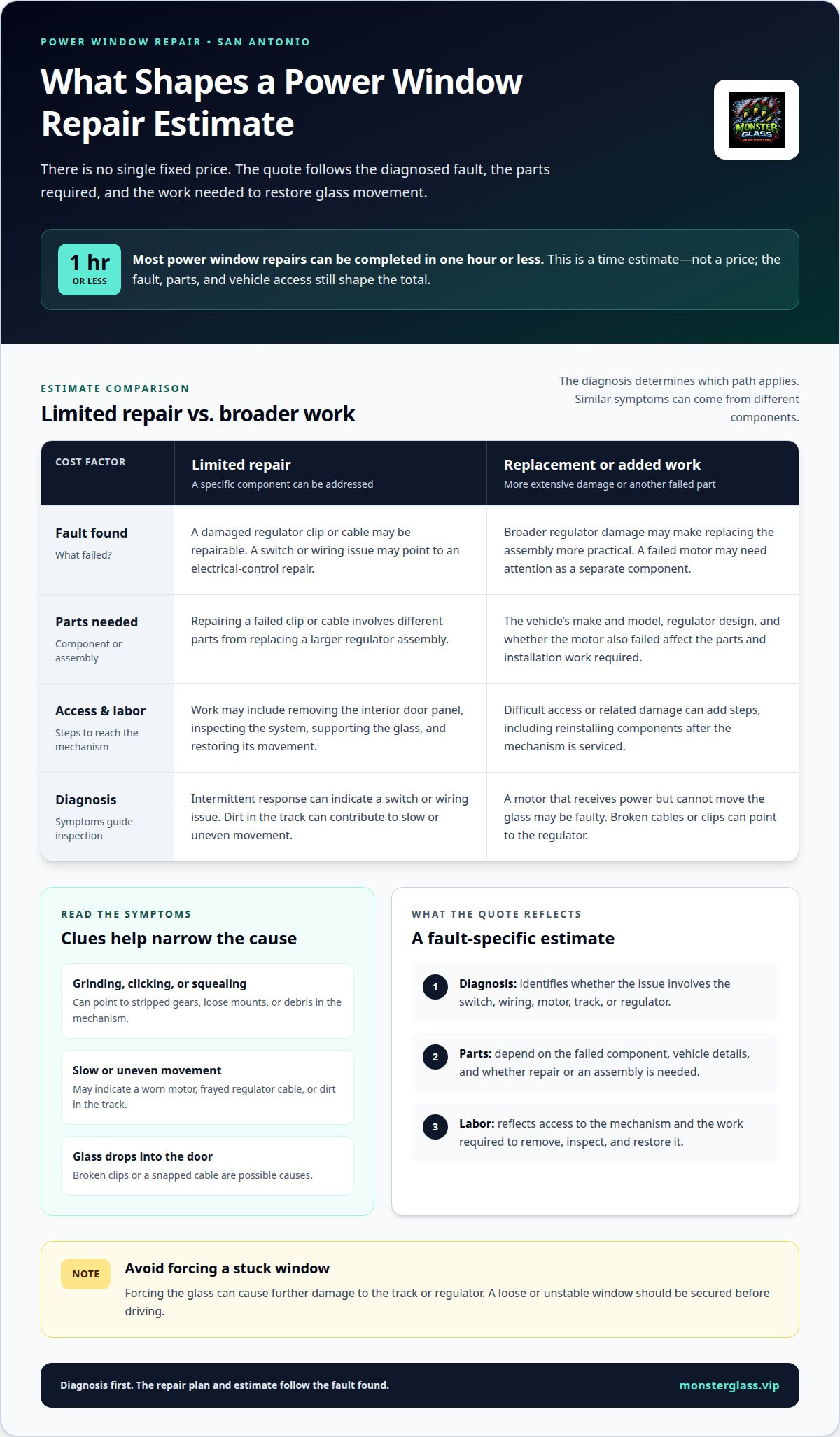
Power window repair costs depend on the failed component, the parts needed, and the work involved. A faulty switch, damaged track, worn pulley, broken cable, or overheated motor can each require a different fix, so the estimate follows diagnosis. For auto window regulator repair, the key cost factor is whether a damaged component can be repaired or the assembly needs replacement.
Listen and watch as the window operates. Grinding, clicking, or squealing can point to stripped gears, loose mounts, or debris in the mechanism. Slow or uneven movement may indicate a worn motor, frayed regulator cable, or dirt in the track. If the glass drops into the door, broken clips or a snapped cable are possible causes. Exposure to snow or ice can also contribute to power window failure.
To distinguish a regulator fault from a motor or switch problem, a technician uses diagnostic tools to trace where operation stops. Intermittent response can indicate a faulty switch or wiring. If the motor receives power but cannot move the glass, the motor may be at fault; damaged cables or clips can point to the regulator.
Part costs vary by vehicle make and model. The regulator design and whether the repair needs separate components or an assembly affect the parts estimate, so the vehicle details and diagnosis determine the quote.
The estimate also reflects access to the mechanism and the labor required to remove the interior door panel, inspect the system, and restore glass movement. Experienced technicians can complete most power window repairs in one hour or less. That timing is not a price: parts and the specific fault still shape the total.
- Switch or wiring: Intermittent response can direct diagnosis toward the electrical controls.
- Motor: A powered motor that cannot move the glass may need attention.
- Regulator: Broken cables, clips, or related hardware can interrupt glass travel.
- Track: Dirt or damage can make movement slow, uneven, or noisy.
Can a window regulator be repaired, or does it always need replacement?
Repair may be possible when damage is limited to certain components; more extensive failures may call for replacement. The decision depends on what holds, moves, or powers the glass.
Regulator Repair or Replacement
A technician can repair a regulator when only its clips or cables have failed. If the mechanism has broader damage, replacement may restore controlled glass movement more reliably than repairing one isolated part. The inspection should identify the failed component and whether the remaining regulator can operate correctly. A window that drops into the door needs prompt attention because broken clips or a snapped cable may be involved.
Motor Repair or Replacement
A motor fault calls for a different remedy from a regulator failure. The faulty component can be replaced without assuming the entire window mechanism needs changing. Diagnosis helps distinguish a motor problem from a failed regulator, switch, or wiring issue. Slow or uneven glass movement can indicate a worn motor, but regulator cables or dirt in the track can cause similar symptoms.
OEM and Aftermarket Part Choices
OEM parts are made to a vehicle’s original specifications, while aftermarket parts come from other manufacturers. Neither label alone establishes whether a part suits a specific repair. Compatibility with the vehicle, correct mounting points, and operation with the existing window system are the relevant factors. A technician can use the vehicle details and diagnosed failure to select an appropriate part that fits and supports smooth glass travel.
Replacement Timing, Tools, and Safety
Replacement time varies with vehicle access and whether the motor or other components also need work. Proper tools and a vehicle-specific procedure help technicians remove the door trim, support the glass, and install the regulator without stressing the window. A loose or unstable window should be secured before driving; a window stuck open also exposes the interior to weather and moisture. Avoid forcing the glass, which can further damage the track or regulator. For a diagnosed regulator fault, professional window regulator repair can address the mechanism and restore operation.
Power window repair costs
The repair total reflects the diagnosed fault, parts, and labor, not simply the age of the vehicle. A switch problem, a damaged regulator, and a failed motor involve different components and repair steps. The price depends on the case and is provided after a quote request; the estimate reflects the diagnosis, parts required, vehicle access, and work involved.
Diagnosis matters because similar symptoms can have different causes. For example, a slow-moving window may have a worn motor, a frayed cable, or dirt obstructing its track. The repair plan depends on the finding: cleaning an obstructed track differs from replacing damaged hardware. Noise alone does not identify the part that needs work, so the cause must guide the estimate.
Parts are another cost factor. Repairing a failed clip or cable differs from replacing a larger regulator assembly. The vehicle’s make and model also matter because the required part and access to the mechanism vary. If the motor has failed alongside the regulator, the estimate must account for that additional component and installation work.
Labor depends on the steps needed to reach and restore the window mechanism. Removing a door panel, supporting the glass, accessing the regulator, and reinstalling components all form part of the work. Difficult access or related damage can add steps beyond a straightforward component replacement. The estimate should reflect the actual repair, rather than treating every inoperative window as the same job.
- Diagnosis: Identifies whether the fault involves the switch, wiring, motor, track, or regulator.
- Parts: Depends on which component failed and whether repair or replacement is needed.
- Labor: Reflects access, removal, installation, and reassembly steps.
- Related damage: Additional failed components can change the scope of work.
Before approving work, use the estimate to understand which component will be repaired or replaced and what labor is included. For example, a quote for a regulator assembly should correspond to a diagnosed regulator issue, not simply the symptom of a stuck window. A clear scope makes it easier to understand why one repair differs from another.
Warranty and final window testing
Written coverage terms and a systematic operation test help clarify what to expect after a window repair. Both matter before the vehicle returns to regular use.
Warranty and Insurance Coverage
A vehicle warranty or insurance policy covers a regulator repair only when its written terms apply to the failure and circumstances. The cause of the damage and the policy’s exclusions can affect coverage. For example, a mechanical failure and damage from an outside event may be treated differently. Review the relevant terms before assuming either one pays for the repair.
For repair workmanship, warranty terms should identify which work or parts they cover, how long coverage lasts, and what exclusions apply. Keep the estimate and repair paperwork together. These details help distinguish a parts issue from a new symptom, such as a window becoming noisy after service. A written coverage statement is more useful than assuming every repair includes the same protection.
Final Window Testing
After installation, the technician should operate the window through its full travel using the vehicle’s switch. The glass should move smoothly, remain aligned in its track, and stop at the intended positions. Testing movement in both directions can reveal binding that a brief switch press might miss. The technician should also listen for clicking, scraping, or other unusual sounds.
A careful final check includes the window’s response to the controls and whether the glass sits evenly when closed. If the vehicle has a window lock, testing should account for its effect on operation. The door trim should also be seated properly after the mechanism is accessed, with no loose panel or obstructed switch.
- Movement: Confirm smooth travel in both directions.
- Alignment: Observe whether the glass stays level in its track.
- Sound: Listen for new scraping or clicking.
- Controls: Test the switch and window lock response.
For a window that still binds or stops unevenly after service, arrange window regulator repair to address the mechanism and restore proper movement.
Monster Glass: General Auto Glass Replacement
Monster Glass provides Window Regulator Repair for power window mechanism problems. If the glass itself is damaged, Car Window Replacement may be the appropriate solution instead. Identifying whether the problem involves the regulator or the glass helps determine the right next step.
For drivers in San Antonio, Monster Glass also provides General Auto Glass Replacement, Windshield Replacement, and Windshield Rock Chip Repair. These services address different kinds of glass damage, while regulator repair focuses on window movement. A window that drops, binds, or stops responding may need its mechanism assessed; cracked or broken glass may call for replacement.
Contact Monster Glass to discuss your window concern and arrange the service that fits it.
Take the Next Step Toward a Working Window
A power window that sticks or stops responding can disrupt daily driving. Have the fault assessed before it causes further damage. Details such as when the glass stops or whether it moves unevenly can help explain the problem. A technician can determine whether auto window regulator repair fits the issue or another glass service is needed.
Monster Glass provides Window Regulator Repair for mechanism problems, along with General Auto Glass Replacement and Windshield Replacement. If the issue is damaged glass rather than window movement, Car Window Replacement may be the relevant service. Monster Glass also provides Windshield Rock Chip Repair for chips that need attention.
Contact Monster Glass about window repair to discuss the symptoms and an appropriate next step. With the right diagnosis, you can move toward restoring clear visibility and dependable window operation with confidence.
Frequently Asked Questions
What causes power windows to stop working?
Power windows stop working when an electrical or mechanical component fails. Common causes include faulty switches, damaged wiring or tracks, worn pulleys, broken regulator cables, and overheated motors. A window that responds intermittently can point to its switch or wiring, while one that drops into the door may have failed support components. Snow or ice exposure can also contribute to a failure.
Can I manually push up a stuck electric window?
A stuck electric window may sometimes be pushed up and temporarily secured in an emergency, but forcing the glass can further damage the regulator or tracks. Stop if the glass resists or sits at an angle. A window left open exposes the vehicle interior to moisture and weather, so arrange repair rather than relying on a temporary position for regular use.
Do you offer electric window repair near me?
Yes. Monster Glass LLC provides Window Regulator Repair in San Antonio and nearby communities, including Alamo Heights, Terrell Hills, Olmos Park, Leon Valley, Castle Hills, Shavano Park, Helotes, Balcones Heights, Kirby, Converse, Windcrest, Live Oak, Universal City, and Von Ormy. The service addresses window mechanism problems. If the glass itself is damaged, Car Window Replacement may be the relevant service.
How can I care for my power window to prevent issues?
Keep window tracks and moving parts clean, and periodically apply silicone-based lubricant to tracks, rollers, and other moving components. Avoid petroleum-based products because they can attract dust and debris. If the glass begins moving unevenly or makes unusual sounds, avoid repeatedly operating the switch; continued use can put extra strain on the mechanism before the cause is addressed.
How do vehicle power windows work?
A power window uses a button or switch to operate its motor and move the glass through a regulator. The regulator guides and supports the glass as it travels inside the door. Many vehicles also have a safety lock that prevents passengers from operating windows. Most power windows stop working when the vehicle stops, although some have a brief operating delay.
Is it worth fixing a power window?
Repair is worth considering when a failed window disrupts daily use, leaves the vehicle exposed, or prevents the glass from closing properly. A technician’s diagnosis identifies the faulty component and appropriate remedy. If the glass is broken rather than simply unable to move, Car Window Replacement addresses the glass itself. Professional auto window regulator repair can restore operation when the mechanism is at fault.


