

A small chip or short crack may be repairable, but damage in the driver’s line of sight, reaching the windshield edge, or penetrating both glass layers points toward replacement. Knowing when to replace a cracked windshield starts with where the damage is and how deeply it reaches, not just how it looks from the driver’s seat.
It’s natural to hope a quick repair will be enough, and many minor chips can be repaired before they spread. This guide explains how crack size, depth, and location help distinguish repairable damage from damage that calls for a new windshield. You’ll also learn how temperature changes can worsen a crack, what to consider about insurance, and why windshield laws vary by state. These factors can help you choose the right next step for your vehicle.
Key Takeaways
- Use the damage’s size, depth, and position to judge whether a repair may be suitable or full replacement is the safer route.
- Review your insurance coverage and deductible before deciding how to handle windshield damage.
- Limit temperature swings and address fresh damage promptly to reduce the chance of a small chip spreading.
- Check the windshield rules that apply in your state, since requirements can vary across the United States.
Does car insurance cover windshield damage?
Insurance coverage depends on your policy, so review its glass-damage terms, deductible, and claim process before deciding between repair and replacement. A chipped windshield may qualify for repair, while extensive damage may call for replacement. Location matters too: damage in the driver’s line of sight should not be repaired, even when the chip or crack looks small. A repair can leave a visible mark where the driver needs a clear view.
Several damaged areas can affect the decision. Multiple chips may leave less room for a durable repair, especially if they affect visibility or sit close together. A crack that reaches from edge to edge weakens structural integrity and requires replacement. Damage that penetrates more than halfway through the glass, or through both layers of laminated glass, also calls for replacement. Repeat impacts from debris can add new fractures to an existing crack.
Temperature changes can make a small crack spread. Rapid shifts, such as moving from a cold setting to hot conditions, stress damaged glass. Driving vibrations and another impact can worsen it further. Addressing a fresh chip promptly can help prevent it from growing into damage that needs full windshield replacement.
Use this comparison to organize your decision and insurance review:
| Option | Damage and location | Insurance step |
|---|---|---|
| Repair | Small chip or crack outside the driver’s line of sight, not deeply penetrated | Check whether your policy covers repair and what deductible applies |
| Replace | Edge-to-edge crack, deep penetration, or damage obstructing the driver’s view | Review replacement coverage, deductible, and claim requirements |
To decide when to replace a cracked windshield, weigh visibility, depth, spread, and the combined effect of multiple impact points, not just the size of one chip.
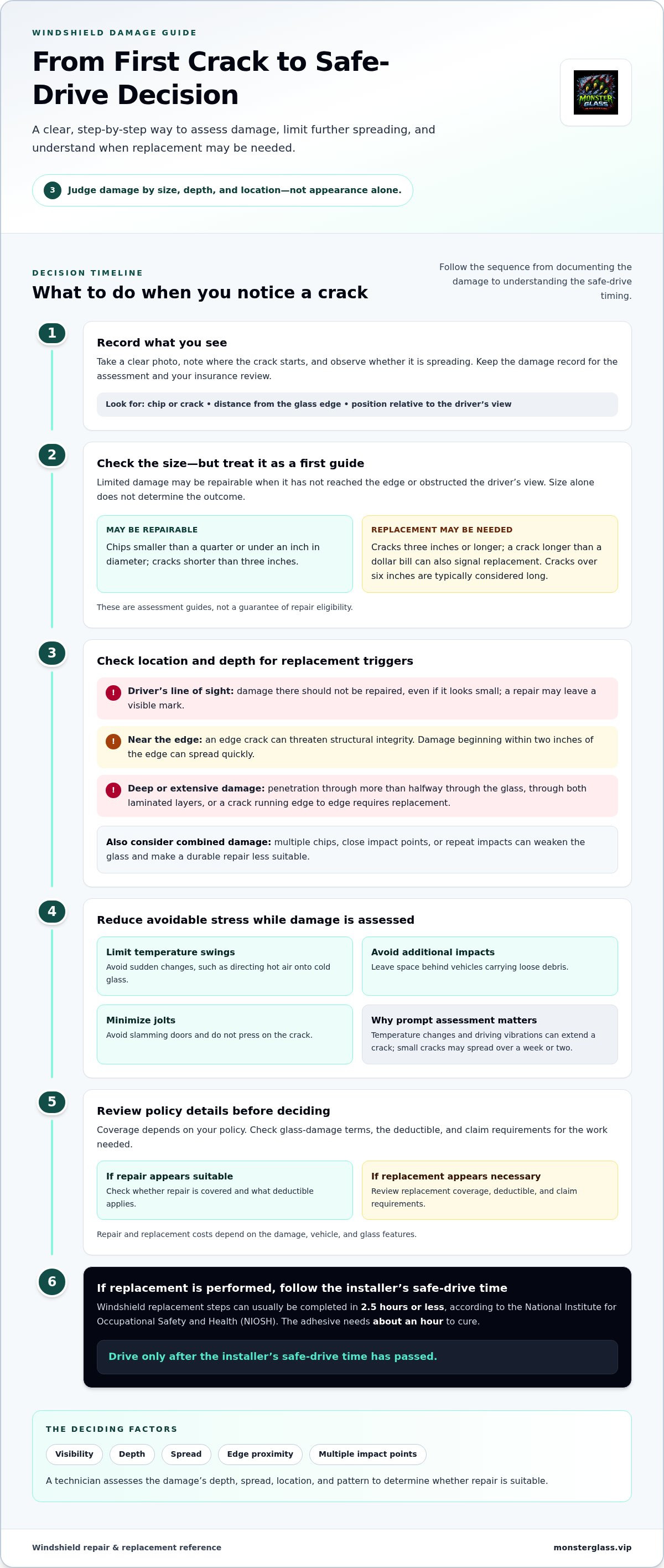
Windshield replacement steps can usually be completed in 2.5 hours or less, according to the National Institute for Occupational Safety and Health (NIOSH). Adhesive needs about an hour to cure; drive only after the installer’s safe-drive time has passed.
How do I know if my windshield can be repaired?
Repairability depends on the chip or crack’s size, depth, and location. These criteria help distinguish damage that may be repairable from damage that calls for a new windshield.
Repairable Chips and Cracks
A small chip or short crack may qualify for windshield repair if it hasn’t reached the glass edge or obstructed the driver’s view. Chips smaller than a quarter can often be repaired, as can cracks shorter than three inches. A repair fills the damaged area but may leave a visible mark. Prompt attention helps limit further spreading.
Repair Versus Replacement
Repair preserves the existing windshield and suits limited damage that hasn’t compromised visibility or glass integrity. Replacement is the better course when damage is extensive, deeply penetrated, or positioned where a repair could interfere with the driver’s view. A crack longer than a dollar bill may signal that replacement is needed. Multiple impact points also matter because their combined effect can weaken the glass.
Repair Eligibility Thresholds
Use size as an initial guide, not the only test. Chips under an inch in diameter and cracks under three inches may be repairable, while cracks three inches or longer may require replacement. A crack over six inches is typically considered long. Damage that penetrates more than halfway through the glass, or through both laminated layers, requires replacement.
Location can outweigh size. Damage in the driver’s line of sight should not be repaired, and a chip near the edge can compromise the windshield. An automotive glass technician examines the damage’s depth, spread, and position before deciding whether repair is suitable.
Insurance coverage depends on your policy and deductible, so review both before filing a claim. Repair and replacement costs depend on the damage, vehicle, and glass features. The price depends on the case and is given after a quote request.
If a small chip meets repair criteria, windshield rock chip repair can address the damage before it spreads.
Preventing chips and cracks from spreading
After noticing a crack, photograph it and arrange a prompt assessment. Limit temperature swings and avoid repeat impacts from debris, which can extend existing damage.
Windshield damage can appear as a small chip, a spreading crack, or an edge crack. Each behaves differently: temperature changes and driving vibrations can push a short crack outward, while edge damage can threaten structural integrity. A technician considers the chip or crack’s location, depth, and pattern when assessing the auto glass.
Large Cracks or Chips for Replacement
Extensive damage differs from a contained chip because it can affect a wider area of the windshield. An edge-to-edge crack weakens structural integrity and requires replacement. An edge crack beginning within two inches of the glass edge can spread quickly, so prompt assessment matters. Repeat impacts or several damaged areas can also make repair unsuitable. Insurance coverage depends on the policy and the work needed.
Actions After Noticing a Crack
Act early rather than waiting to see whether the damage grows. Take a clear photo, note where the crack starts, and arrange an auto glass assessment. Until then, avoid sudden temperature changes, such as directing hot air onto cold glass. Leave space behind vehicles carrying loose debris, since another impact can add damage and complicate the repair decision.
Small cracks can spread over a week or two as temperatures fluctuate and driving vibrations stress the glass. Avoid slamming doors, which can jolt a damaged windshield, and don’t press on the crack. These steps can’t reverse existing damage, but they reduce avoidable stress while you arrange an evaluation.
Replacement is appropriate when a crack runs from edge to edge or a chip has compromised the glass too deeply. A technician considers the damage pattern, location, and structural integrity rather than relying on appearance alone. For insurance, keep photos and the date you first noticed the crack; these details can help document the damage when you review your policy.
State windshield laws
Windshield rules in the United States vary by state, so a crack that is legal in one place may cause a problem elsewhere. In most states, driving with a cracked windshield is against the law. Consider the crack’s position, visibility, and effect on safe driving, not just its length.
Federal rules also address certain damage patterns. The U.S. Government Publishing Office states that federal law prohibits driving with two windshield cracks within three inches of each other. This is a specific rule about two cracks and their spacing; it doesn’t describe every state’s requirements or cover every possible damage pattern. Keep that distinction in mind when assessing multiple cracks.
Line of sight is a practical concern in any state. A crack or chip in the area the driver looks through can interfere with visibility, especially when sunlight, headlights, or rain affect the view. Damage can also spread with temperature changes or repeat impacts. Clear visibility and intact structural glass matter during everyday driving, not only during an inspection.
Inspection requirements differ by state, and some locations assess windshield condition as part of vehicle inspections. Where an inspection applies, damage that blocks the driver’s view or compromises the glass may affect the result. Don’t assume a general rule settles your case: the state, damage location, and inspection criteria all matter. Before driving with a damaged windshield, identify the rules that apply where the vehicle is registered and driven.
Use these practical steps: note the crack’s position, count separate damaged areas, and compare their spacing. Then consider whether the driver’s view is affected and whether the glass remains structurally sound. If damage is extensive or visibility is compromised, replacement addresses the glass condition instead of relying on a repair that leaves the defect in place.
For a windshield that needs replacement, schedule windshield replacement to restore clear, sound glass.
Monster Glass: Windshield Replacement
Monster Glass LLC serves drivers in San Antonio and nearby communities, including Alamo Heights, Terrell Hills, Olmos Park, Leon Valley, Castle Hills, and Shavano Park. If a crack affects your view, reaches the glass edge, or compromises the windshield, Monster Glass LLC provides windshield replacement. For limited rock-chip damage, windshield rock chip repair may be suitable. The right service depends on the damage’s location, size, and depth.
Monster Glass LLC also serves Helotes, Balcones Heights, Kirby, Converse, Windcrest, Live Oak, Universal City, and Von Ormy. General auto glass replacement and car window replacement address damage to other vehicle glass, separate from the windshield.
Note where the damage starts, whether it has spread, and whether it interferes with your view. These details can help clarify the next step. Contact Monster Glass LLC to discuss your damaged windshield and the appropriate service.
Take the Next Step Toward Clearer Driving
Turn what you’ve noticed into a practical plan. Record where the damage sits and whether it changes as you drive, then use those details to discuss an appropriate solution. Knowing when to replace a cracked windshield is easier when you focus on the glass condition and your visibility instead of waiting for the damage to worsen.
Monster Glass provides windshield replacement for damage that calls for a new windshield, windshield rock chip repair for eligible small damage, and general auto glass replacement for other damaged vehicle glass. The right service depends on the affected glass and the condition of the damage.
If you’re ready to discuss your windshield, contact Monster Glass for help. A clear next step can make it easier to get back to driving with confidence.
Frequently Asked Questions
Can a chipped or cracked windshield pass inspection?
It depends on the state and how the damage affects visibility and safe driving. Windshield inspection requirements vary, so there isn’t one nationwide pass-or-fail rule for every chip or crack. Before an inspection, note whether damage sits in the driver’s viewing area, spreads across the glass, or creates multiple damaged spots. These details can affect how the windshield is assessed under local requirements.
How much does it cost to replace a windshield?
The price depends on the vehicle, replacement glass, and any required work on embedded cameras or sensors. It also depends on whether the damage is limited to the windshield or involves other glass. Insurance coverage and your deductible can affect what you pay out of pocket. For a specific estimate, the price depends on the case and is given after a quote request.
Is it safe to drive with a cracked windshield?
Driving with a crack that obstructs your view can make it harder to see road hazards, signs, or other vehicles. A crack can also grow after temperature changes or another impact, changing your view during a trip. If damage blocks your line of sight or compromises the glass, don’t assume the vehicle is safe to drive; arrange an assessment before resuming regular driving.
When does a cracked windshield need immediate replacement?
Replacement is needed when a crack runs from edge to edge or damage penetrates both layers of laminated glass. A crack in the driver’s viewing area also shouldn’t be repaired, since a repair can leave a visible mark. If the damage is growing, affects visibility, or reaches the windshield edge, arrange a prompt assessment rather than waiting for another impact.
Can a cracked windshield be repaired instead of replaced?
Yes, some limited chips and cracks can be repaired when their position and depth allow a sound repair. For example, a small chip outside the driver’s viewing area may be a candidate. A repair can leave a visible blemish, so the driver’s sightline matters even when the damaged area is small. Multiple impact points or deeper damage can change the decision.
How long or wide can a windshield crack be to qualify for repair?
A crack shorter than three inches can usually be repaired, while cracks three inches or longer may require replacement. A chip under an inch in diameter may also qualify. Treat these measurements as starting points, not a complete test: depth, location, proximity to the edge, and whether damage crosses both glass layers also matter. Measure the damaged area and note where it sits before arranging an assessment.
